

Description
Introduction
Enterprise sales is one of the most valuable and challenging areas of modern business growth. Unlike simple transactions, enterprise deals involve multiple decision-makers, longer sales cycles, complex negotiations, and a strong focus on creating measurable business value.
Companies investing in enterprise solutions are not only purchasing a product or service. They are looking for reliable partners who understand their challenges, provide strategic solutions, and help them achieve important business outcomes.
Successful enterprise selling requires more than traditional sales techniques. It requires a structured approach that combines relationship building, strategic communication, customer research, negotiation skills, and a deep understanding of buyer psychology.
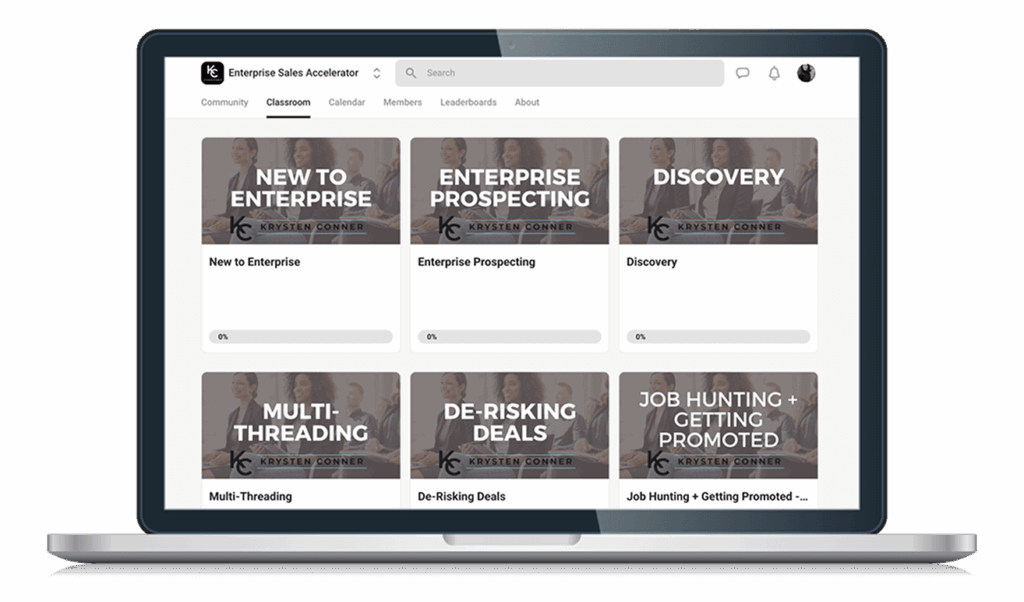
Krysten Conner – Enterprise Sales Accelerator represents a strategic framework designed to help sales professionals and businesses improve their ability to manage complex sales opportunities, create stronger pipelines, and increase revenue performance.
This detailed guide explores the principles behind enterprise sales success, including prospecting, relationship development, sales processes, closing techniques, and scalable growth strategies.
The Evolution of Enterprise Sales
The sales industry has changed significantly over the past decade.
Traditional sales approaches often focused on:
- Product features
- Cold outreach
- Short-term transactions
- Immediate closing
Modern enterprise sales focuses on:
- Business outcomes
- Customer challenges
- Long-term partnerships
- Strategic value
Large organizations expect sales professionals to understand their industry, goals, and operational challenges before presenting solutions.
The modern salesperson acts more like a business advisor than a traditional seller.
Understanding Complex B2B Sales
Enterprise sales differs from regular sales because the buying process involves multiple factors.
A typical enterprise purchase may involve:
- Executives
- Managers
- Financial teams
- Technical departments
- End users
Each person may have different priorities.
For example:
Executives may focus on:
- Revenue impact
- Business growth
- Strategic advantages
Managers may focus on:
- Efficiency
- Team performance
- Implementation
Technical teams may focus on:
- Security
- Integration
- Reliability
Successful sales professionals understand these different perspectives.
The Importance of Value-Based Selling
One of the biggest differences between average and successful enterprise sellers is the ability to communicate value.
Customers do not simply buy products. They buy solutions to problems.
A strong sales approach focuses on:
- Business challenges
- Desired outcomes
- Financial impact
- Long-term benefits
Instead of saying:
“Our product has these features.”
A stronger approach is:
“Our solution helps your organization achieve this specific result.”
Value-based selling creates stronger conversations and improves customer confidence.
Building a Strong Enterprise Sales Foundation
A successful sales process begins with preparation.
Understanding Your Ideal Customer Profile
Before contacting prospects, businesses need clarity about who they want to work with.
An ideal customer profile includes:
- Industry
- Company size
- Business challenges
- Buying behavior
- Growth goals
Better targeting improves sales efficiency.
Researching Potential Accounts
Enterprise buyers expect personalized conversations.
Effective research includes:
- Company information
- Market position
- Recent developments
- Business priorities
- Potential challenges
Research helps sales professionals create meaningful conversations.
Developing a High-Performance Sales Process
A repeatable sales process helps businesses create predictable results.
A strong enterprise sales process includes several stages.
Prospecting and Opportunity Creation
The first step is identifying potential customers.
Effective prospecting methods include:
- Professional networking
- Strategic outreach
- Referrals
- Industry research
- Content marketing
The goal is not contacting everyone. The goal is finding qualified opportunities.
Discovery Conversations
Discovery is one of the most important stages of enterprise selling.
The purpose is understanding:
- Current problems
- Business objectives
- Existing solutions
- Decision-making process
- Success measurements
Strong discovery questions create better sales conversations.
Examples include:
- What challenges are affecting your business growth?
- What improvements are you hoping to achieve?
- How are you currently solving this problem?
Solution Presentation
A strong presentation connects the solution directly to customer needs.
Effective presentations focus on:
- Customer challenges
- Expected outcomes
- Implementation process
- Business impact
The best sales presentations are customized rather than generic.
Creating Effective Sales Conversations
Communication is at the center of enterprise sales success.
Asking Better Questions
Great sales professionals spend more time understanding than talking.
Strong questions uncover:
- Customer priorities
- Hidden problems
- Decision factors
- Budget considerations
Better questions lead to better solutions.
Building Trust and Credibility
Enterprise buyers need confidence before making large decisions.
Trust is built through:
- Expertise
- Transparency
- Consistency
- Professional communication
A trusted advisor is more valuable than a simple salesperson.
Handling Objections Professionally
Objections are a natural part of complex sales.
Common objections include:
- Price concerns
- Timing issues
- Internal approval challenges
- Competition
Successful sellers do not argue against objections. They understand the concern and provide clarity.
Lead Generation and Pipeline Growth
A strong pipeline is essential for consistent sales performance.
Creating Multiple Lead Sources
Businesses should avoid depending on only one acquisition channel.
Potential sources include:
- Referrals
- Networking
- Content creation
- Strategic partnerships
- Outreach campaigns
Diversified lead generation creates stability.
Improving Sales Qualification
Not every opportunity is worth pursuing.
Qualification helps identify:
- Budget availability
- Decision authority
- Business need
- Purchase timeline
Better qualification improves efficiency.
Managing the Sales Pipeline
A healthy pipeline requires Sales Pipeline Growth, Revenue Growth Strategy, Sales Training, Sales Process Optimization, Business Development, Sales Leadership, Customer Acquisition, Strategic Selling, Sales Funnel, Lead Generation Strategy, Sales Negotiation, Closing Techniques, Sales Psychology, Account Based Selling, Enterprise Business Growth, Sales Management, B2B Marketing, Customer Relationship Management, Sales Enablement, Sales Performance, Professional Selling, Consultative Selling, Value Based Selling, Sales Team Growth, Revenue Operations, Business Sales Strategy, Sales Coaching, Growth Strategy, Modern Sales Techniques, Enterprise Account Management, Sales Success Framework, Digital Sales Strategy, Sales Automation, Customer Success regular attention.
Important activities include:
- Tracking opportunities
- Following up consistently
- Updating forecasts
- Prioritizing high-value accounts
Pipeline management improves predictability.
Negotiation and Closing Strategies
Closing enterprise deals requires patience and strategy.
Creating Win-Win Negotiations
Strong negotiations focus on creating value for both sides.
Successful negotiation includes:
- Understanding customer priorities
- Communicating benefits
- Finding common ground
Working With Multiple Decision-Makers
Enterprise purchases often require approval from several stakeholders.
Sales professionals should:
- Identify key influencers
- Understand different priorities
- Build internal support
A single contact is rarely enough for large deals.
Creating Urgency Without Pressure
Enterprise buyers need reasons to act.
Effective urgency comes from:
- Business opportunities
- Market changes
- Operational improvements
Pressure-based tactics often damage trust.
Scaling Sales Teams and Systems
Growing revenue requires more than individual performance.
Businesses need systems that support consistent results.
Creating Sales Playbooks
A sales playbook provides guidance for teams.
It may include:
- Messaging frameworks
- Discovery questions
- Objection handling
- Process guidelines
Sales Training and Development
Continuous improvement helps teams perform better.
Training areas include:
- Communication skills
- Negotiation
- Industry knowledge
- Customer psychology
Using Data and Analytics
Sales data helps organizations improve decisions.
Important metrics include:
- Conversion rates
- Sales cycle length
- Pipeline value
- Customer acquisition costs
Data-driven improvements create stronger results.
Common Sales Challenges and Solutions
Challenge: Long Sales Cycles
Enterprise deals often require significant time.
Solution:
Maintain consistent communication and provide ongoing value.
Challenge: Difficulty Reaching Decision-Makers
Large organizations have complex structures.
Solution:
Build relationships across multiple levels.
Challenge: Price Competition
Customers may compare solutions based only on cost.
Solution:
Focus conversations on value and business outcomes.
Challenge: Inconsistent Sales Results
Unstructured processes create unpredictable performance.
Solution:
Develop repeatable systems and sales frameworks.
Frequently Asked Questions
What is Krysten Conner – Enterprise Sales Accelerator?
It represents a strategic approach focused on improving enterprise sales performance through structured processes, stronger communication, and advanced sales strategies.
Why is enterprise sales different from regular sales?
Enterprise sales usually involves larger deals, longer decision processes, multiple stakeholders, and a stronger focus on business value.
How can companies improve enterprise sales performance?
Companies can improve by focusing on:
- Better targeting
- Stronger discovery
- Value-based selling
- Pipeline management
- Sales training
What skills are important for enterprise sales professionals?
Important skills include:
- Communication
- Negotiation
- Strategic thinking
- Research
- Relationship building
Final Conclusion
Enterprise sales success requires a combination of strategy, communication, preparation, and customer understanding.
Krysten Conner – Enterprise Sales Accelerator highlights the importance of developing a structured approach to managing complex sales opportunities and creating meaningful business relationships.
The strongest sales professionals do not focus only on closing deals. They focus on understanding customers, solving important problems, and becoming trusted partners.
By improving sales processes, building stronger pipelines, mastering conversations, and creating scalable systems, businesses can increase revenue and achieve sustainable growth in competitive markets.
Modern enterprise selling is not about pushing products. It is about creating value, building trust, and helping organizations achieve better outcomes.





Reviews
There are no reviews yet.